How the eye works?
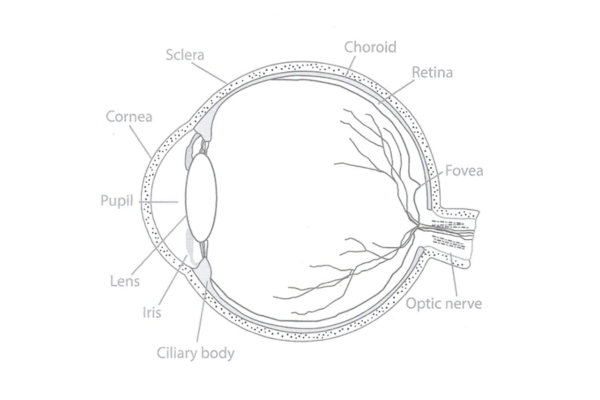
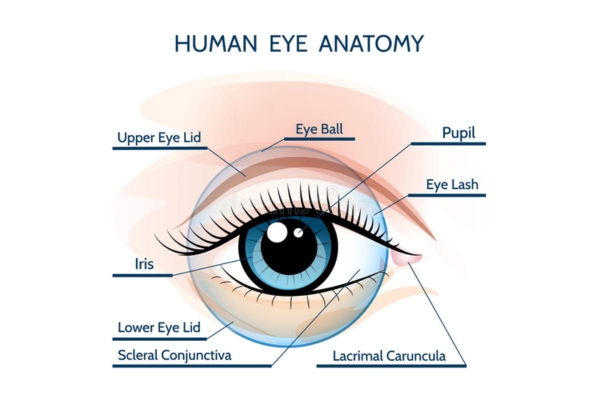
The eye is like a camera. The cornea is a transparent clear, dome-shaped window that forms the front wall of the eye. It shows different colour (Black, Brown, Blue, Green, Hazel etc) because of the Iris, which is situated behind the cornea. The retina is the sensory tissue in the extreme end of the eye that acts like the film in a camera. The cornea at the front of the eye acts as a lens that focuses light on to the retina, producing an image on the retina that gets transmitted to the brain through Optic Nerve which connects our eye to the brain and interpreted as vision
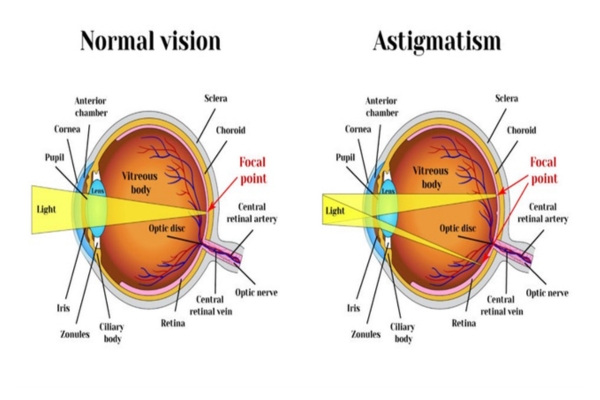
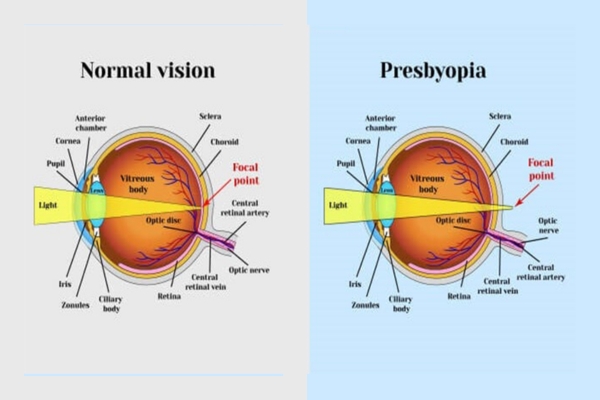
The curvature of the cornea (Normal, Flat or Steep), intraocular lens, and the length of eyeball (Normal, Short or Long), determines whether the incoming light rays from distant objects focus directly onto the retina or Infront or behind the retina.
Emmetropia- Normal eye
All parallel rays from infinity are focused on retina- macula and through optical pathway image is processed and visualised in brain without any aid
Ametropia- Types of Refractive Error
- Ametropia- All parallel rays from infinity are not focused on retina-macula and because of that vision is not clear. Eye will be having Refractive error.
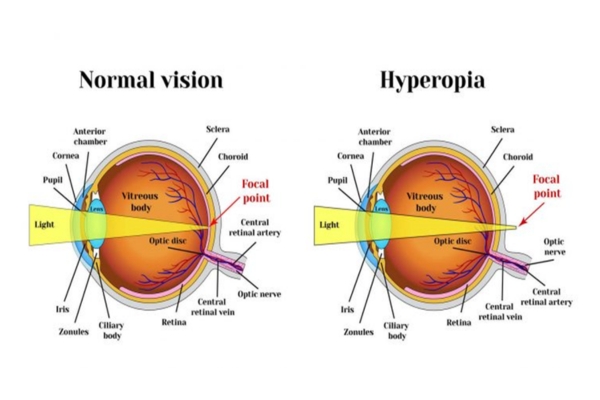
- Depending on where the light rays are getting focused, Refractive Errors are classified as – Myopia, Hypermetropia, Astigmatism, Presbyopia
- Let us understand in details –
Myopia (Near-sightedness)
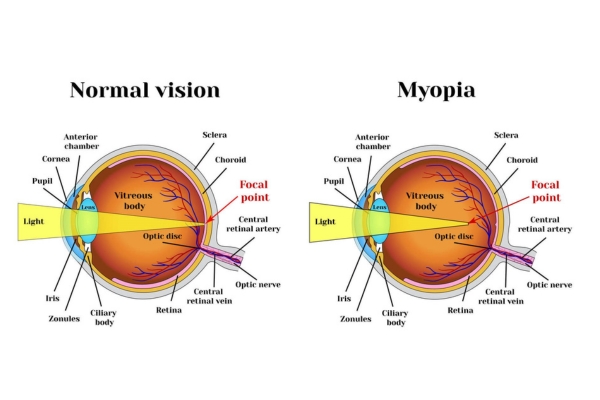
- In myopia, the eye is longer than normal or cornea is more curved then normal or both, which prevents light rays from focusing directly on the retina
- Light rays come together at a point in front of the retina, and are out of focus on the retina
- Distant objects are blurred, while nearby objects can be clear
- Correction is done by concave (Minus) glass
This condition is also described as a “Dysfunctional Lens Syndrome”
The term describes the natural changes in the crystalline lens after approximately age 42. It is a continuum that begins the day, a person is born, basically an aging process of natural lens
About Aberrations
Wavefront:
In optics, Aberration refers to imperfections or distortions in an image caused by the way light rays pass through a lens or optical system.
The input rays are modified by the optical system should converge into a common point image, but in reality, one object point correspond several image points that form a blurred distorted vision/images. This deviation from ideal case is called aberration and is a measure of the optical quality of the system.
Aberration can be quantified either with respect to the expected image point or to the wavefront corresponding to this ideal point.
If we compare the real output wavefront to the ideal one, we call the difference between them “wavefront aberration” and denote it “w”
CLASSIFICATION OF ABERRATIONS:
Our vision is affected by two types of Aberrations (Imperfections or Impurities)
- Lower Order Aberrations– Relatively simple
-
- Account 90% of the overall wave aberration of the eye
- First order aberrations (visually non-significant)
- piston-zero order aberration and prisms
- They affect how much you can see (VA measured by standard chart) but not how well you can see in terms of contrast sensitivity and other fine details
- All refractive errors are “Lower-order aberrations” like Myopia, Hypermetropia and Astigmatism (Distorted Vision)
-
- Relatively small component
- 10% of the eye’s total aberrations
- Increases with age
- They are more complex imperfections of entire eye which includes spherical aberrations, Chromatic aberrations, Coma, Astigmatism, Trefoil etc.
- Mirror symmetry between both eyes
- They influence quality vision as they may lead to disturbances such as Glare, Halos, Night driving problem or decreased contrast sensitivity etc.
- No surface is aberration free
Measurement of Aberrations are done by Aberrometer test, which will measure both higher and lower order aberrations
Correction of Refractive error
- Glass- Normally, all Refractive errors corrected by glasses
- Contact lens- Cosmetic but temporary solution, requires one pairs of glasses and maintenance.
- Permanent solution- Surgical- option to become independent of glass- cosmetic option
-
- Refractive laser surgery – Cornea based solutions (FEMTO LASIK, PRK/Surface Ablation/EPILASIK, KLEx/Lenticule surgeries like SMILEpro/SMILE/SILK/CLEAR/SMARTSIGHT)
- Phakic lens/Permanent Contact lens Implantation- Lens based solution (ICL/IPCL/EYECRYL- Spherical or Toric lens)
Correction of Presbyopia-
- Bifocal contact lens
- Multifocal IOLs
- LASER Refractive Surgery