Basics Of Laser Refractive Surgery

Refractive Error

Refractive Error means, person cannot see distant, near, or distant and near both. For that, Number/Glasses’ /Power is checked which improves the vision and prescription is given to the patient to make glass &/or Contact lens, and see clear.

There are different types of Refractive Error:

  1. Myopia (Near-sightedness),
  2. Hypermetropia (Far-sightedness),
  3. Astigmatism (Either Myopic, Hypermetropic or Mixed) and
  4. Presbyopia (Reading glass after 40 years of age).
Correction of Refractive error

  1. Glasses’ – Routine solution
  2. Contact lens- Temporary Cosmetic option with limitation on usages
  3. ORTHOK lenses- Contact lens to be worn in night time and daytime, enjoy vision without glasses- again a cosmetic option, can also be used as a one of the Myopia control methods.
  4. Permanent solution- Surgical option to become independent of glass- Refractive surgeries/Cosmetic option
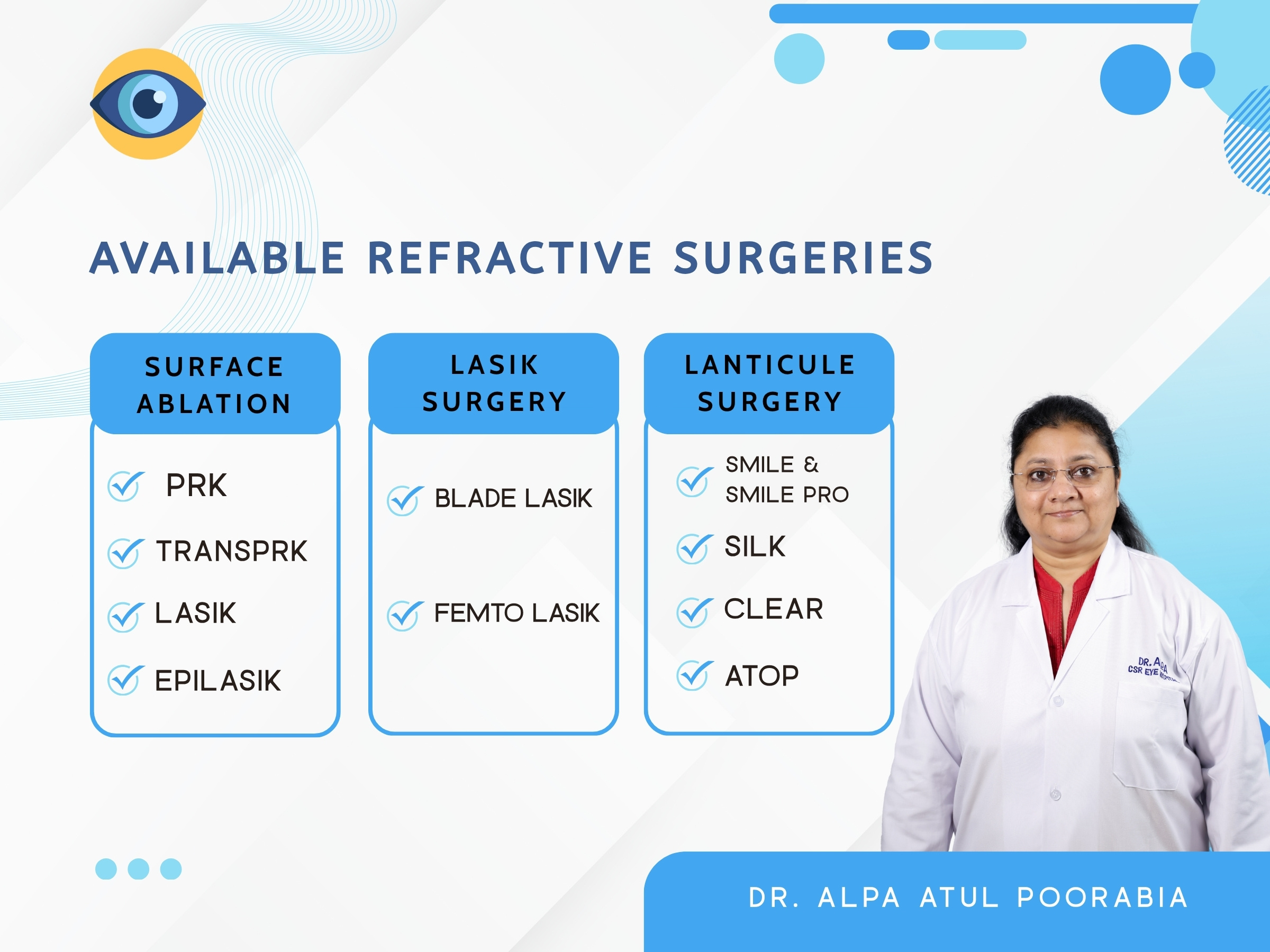
    • Refractive laser surgery – Cornea based solutions (FEMTO LASIK, Surface Ablation (LASEK, EPILASIK, PRK, TRANSPRK), LENTICULE (SMILEpro/SMILE/SILK) SURGERIES)
    • Phakic lens/Permanent Contact lens- Lens based solution (ICL/IPCL/EYECRYL- Spherical or Toric lens)
  1. Correction of Presbyopia-
    • Bifocal contact lens
    • Multifocal IOLs
    • Laser Refractive Surgery

Refractive surgeries:

There are two types of Refractive Surgeries –

  1. Cornea based solutions- where cornea is reshaped by applying laser over it, also known as Laser Refractive Surgery (LRS).

There are three types/Technique of LRS-

    • LASIK (With Blade/Microkeratome LASIK or without Blade/FEMTO LASIK)
    • Surface Ablation (PRK or TRANSPRK or LASEK or EPILASIK), and
    • Kerato-Refractive Lenticule Extraction/KLEx/LENTICULE surgeries – SMILEpro/SMILE/SILK/CLEAR/SMARTSIGHT.

2. Lens based solution -Here the Intraocular Artificial Lens is implanted/positioned inside the eyeball without disturbing any natural structure inside the eye. It is also known as Implantable Phakic Intraocular Lens (PIOL)/Permanent Contact lens- (ICL/IPCL/EYECRYL etc. – Spherical or Toric lens)

Facts about LASER Refractive Surgery (LRS)

  • Patient needs to undergo suitability test, Corneal Topography Test/Scan, to find out how he or she can become glass free, as everyone is not suitable for all Refractive surgeries available today
  • If patient is wearing soft contact lens, then ideally should be stopped for at least 1 week before the test and Semi-soft contact lens should be stopped for at least 2 weeks before undergoing Corneal Topography/Scan. Hard contact lens/ORTHOK lenses should be stopped for a month. Your surgeon will be able to guide you further
  • Suitability Tests- Topography/Scan- There are many Corneal Topography scans are available from different Company. Like – Orbscan II or 3 or Occulyser or Pentacam or Sirius+ or Galilei Corneal Scan or Anteras Scan etc.
  • This scan/topography measures corneal thickness, Cornea power and shape (K Reading) and other irregularities over the cornea/eye
  • Based on the parameters on your Corneal scan, your doctor will guide you and answer couple of questions like –
    • Whether you are suitable for refractive laser surgery or not and if yes which technique/procedure and why
    • Whether patient will be completely glass-free or not or it will be a compromised correction or possibility of residual error
    • Rest after surgery and other care during that time
    • Possible side effects and complications
  • If you are suitable for a particular technique/surgery, means, in a way, Doctor is informing you that, it is safe to undergo the surgery. If you are not suitable for Laser Refractive Surgery or any particular technique, that means, Doctor is informing you that, it is not safe for your eyes, even though you do not have any complaints with your eyes, except glasses.
  • Detailed evaluation of your scan is very important and that decides whether the laser surgery will be safe lifetime or not. In experienced hand (many years of experience), not only instant or short term but even long-term complications are rare
  • Though anyone above 18 years can undergo surgery, 21 years and above should be ideal age
  • Also, the Power (Refractive Error) should be stable for at least last 2 years
  • For Laser Refractive surgery – KLEx/LASIK/PRK- thickness should be at least above 500 µ, but some small power can be corrected (limited cases) by PRK even if the thickness is little less than 500 Microns. My cut off is 480µ thickness, provided all other parameters are within normal limit and refractive error is within range.
  • If the patient is not suitable for Laser Refractive surgery because of poor corneal thickness or some corneal irregularities or has very high or Complicated Refractive Error then that patient can be considered for Phakic lens surgery also known as Permanent Contact Lens Implantation (ICL, IPCL, EYECRYL etc.)
  • For this procedure person should have good Anterior chamber depth (ACD), ideally ≥ 2.8 mm with wide open angles. Your doctor will be able to guide you in detail
  • Detailed Retina examination before any surgery is very important. Pathological changes in the retina should be treated before Refractive Surgery.

Candidate who are not suitable for LASER Refractive Surgery:

  • Perfectionist- It is a pure cosmetic surgery and no one can beat God! Nothing like 100% or Eagle Vision or Instant vision! After all, it is a surgery, though considered and proved to be safe, have side effects and consequences or complications! Please discuss with your doctor in details.
  • It is contraindicated in the people who suffer from Keratoconus or Keratoconus, Suspect/Forme Fruste Keratoconus-FFKC or even have family history of Keratoconus
  • Also contraindicated with Glaucoma or Macula problem or Herpes Infection in the eye
  • Contraindicated in those patients who are on immunosuppressive medications for systemic disease like Rheumatic Diseases, Connective Tissue Diseases etc.
  • Immunodeficient conditions
  • Keloid tendency especially in Surface ablation
  • Relative contraindications include- Refractive error/power is not stable, some suspicion over the scan, pregnancy and lactation, preexisting dry eye, DM, Uveitis,

How Refractive surgery improves quality of life…

  • Makes you glass-free. Reduced or no dependency on Glasses or Contact lens
  • It removes restriction on day-to-day activity which that person would like to do and gives more freedom to their life style e.g. Sportsperson
  • Cosmetic or Aesthetic reason
  • Psychologically dramatic improvement- biggest difference we see in those people, who do not like to wear glasses and not comfortable with contact lenses.

Principle of refractive surgery

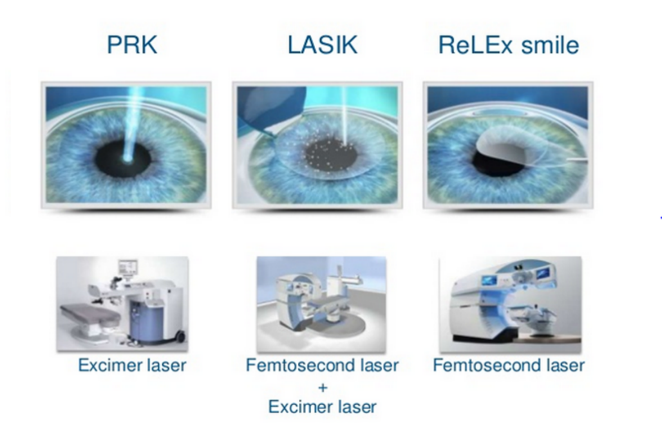
  • In Laser Refractive Surgeries like LASIK and PRK, curvature and shape of the cornea is changed by EXCIMER LASER and, through Femtosecond laser, in KLEx/Lenticule surgery, by removing ultrathin layers (In microns) from the cornea, to correct or reduce the refractive errors or dependency on glass &/or contact lens
  • Changing the shape of the cornea changes the direction of light rays entering the eye. After Refractive surgery, they can focus correctly on the retina-Macula without any aid/glass, resulting in clear vision
  • In case of Myopia, central layers are removed to flatten the cornea (Cornea power is reduced)
  • In case of Hypermetropia- peripheral layers are removed to steepen the cornea (Cornea power is increased)
  • Astigmatism (Myopic or Hypermetropic or mixed)- Make contour/curvature of the cornea like Sphere
  • Presbyopia- Multifocality created on cornea
Refractive laser surgery:
  • Surface Ablation/Photorefractive Keratectomy (PRK) surgery
    • TRANSPRK
    • PRK
    • LASEK
    • EPILASIK
  • Laser Assisted in-situ Keratomileusis (LASIK) surgery
    • MICROKER ATOM LASIK
    • FEMTO LASIK
  • KLEx/KERATO-REFRACTIVE LENTICULE EXTRACTION/Lenticule Procedure:
    • SMILE epro/ SMILE
    • CLEAR
    • SILK
    • SMARTSIGHT
  1. Laser Assisted in-situ Keratomileusis (LASIK) surgery –
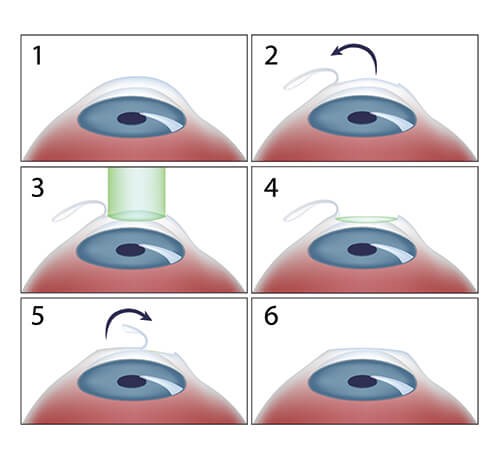
  • In Laser Assisted In-Situ-Keratomileusis (LASIK) Surgery, a cornea is divided or split with small hinge.
  • There are two types of LASIK Surgery-
    1. Microkeratome LASIK/Blade LASIK

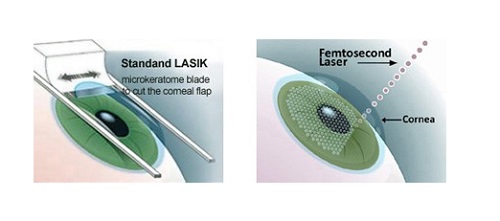
In microkeratome Lasik, a cornea is shaved with an instrument called a Micro- keratome (blade cut)- a specialized instrument to create a flap.

    1. Femto LASIK/All LASER LASIK/Blade Free LASIK/100% LASER LASIK

In Femto LASIK, the corneal flap is created by another LASER called Femtosecond (All LASERs or 100% blade-free). Here Femtosecond laser produces compactly arranged tiny air bubbles at the level where cornea to be cut, and flap is created, because of this, the plane become loose and you can easily peel/separate and lift it

  • The upper part of the cornea which is known as “Flap” is then lifted like a page of paper through hinge of the flap and then the Sate-of-the-art Excimer laser is applied on the exposed stromal bed of the cornea to reshape and correct refractive error
  • The Excimer laser will reshape the cornea by removing pre-determined ultrathin layers. The amount of tissue to be removed is calculated based on the preoperatively determined power of your eye; these measurements are usually in agreement with recent prescriptions for your glasses
  • The result of removing thin layers of tissue causes the center of the cornea to flatten in case of near-sightedness, or steepen in case of farsightedness, or become more rounded in the case of astigmatism, which changes the focusing power of the cornea
  • The flap is then returned to original position which bonds back into place without the need for stitches, pad or contact lens or bandage, as within seconds natural forces (Endothelial cell pump) hold the flap back in position over the cornea
  • Usually, within a few hours, the surface layer of the cornea (epithelium) begins to grow over the edge of the flap to seal it into position and within days, collagen bonds form within the cornea around the edge of the flap, and seals it
  • Advantage- because we position the flap back, next day onwards, vision starts improving
  • Recovery is very fast
LASIK PROCEDURE
Surface Ablation/Photorefractive Keratectomy (PRK) surgery
  • PRK procedure was first performed in 1987
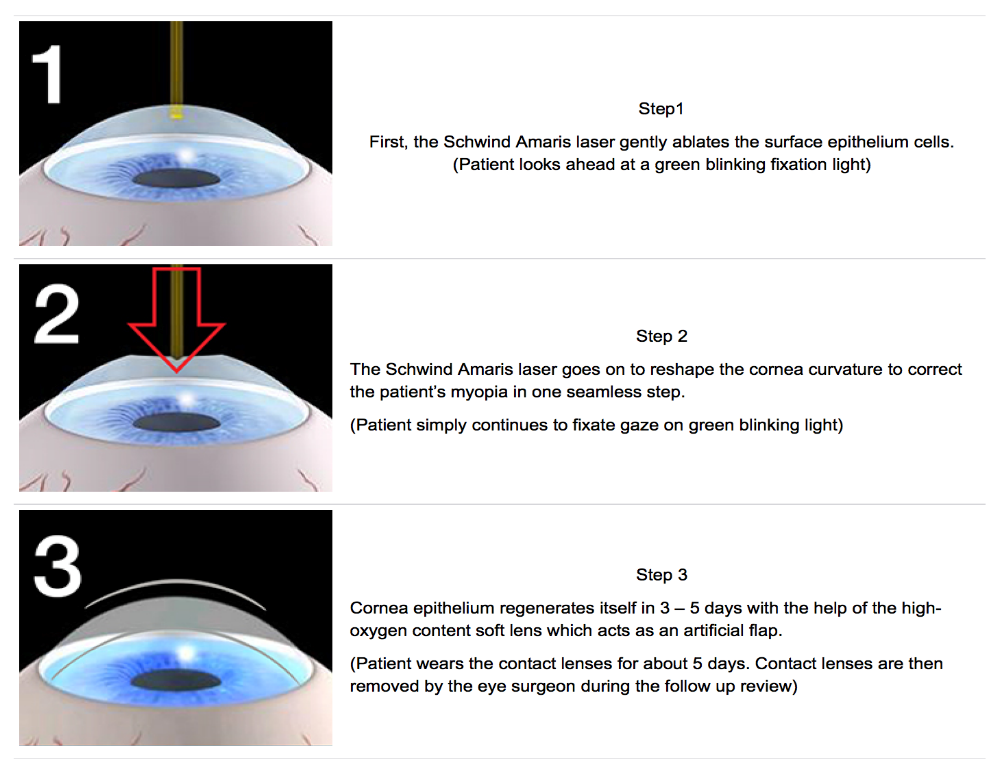
  • In this procedure, a first layer of cornea, called corneal epithelium, is being removed and directly Excimer laser is applied on cornea to correct refractive error
  • There are different ways to remove corneal epithelium-
    • Traditional PRK– here corneal epithelium is removed mechanically by instrument- most performed surgery till today
    • LASEK– By applying Absolute Alcohol on the cornea, the epithelium is removed. It is a crude method to remove the epithelium and that is why not commonly used in Laser Refractive Surgery
    • EpiLASIK – Sharpener is used to cut first layer of the cornea- no added advantage
    • TRANSPRK– Most recent and very popular method, here the corneal epithelium is removed with Excimer Laser
TRANSPRK Method
  • After removing corneal epithelium, the Excimer laser applied, which will reshape the cornea by removing pre-determined ultrathin layers
  • The amount of tissue to be removed is calculated based on the preoperatively determined power of your eye; these measurements are usually in agreement with recent prescriptions for your glasses and/or contact lenses
  • The result of removing thin layers of tissue causes the center of the cornea to flatten in the case of near-sightedness, or steepen in the case of farsightedness, or become more rounded in the case of astigmatism, which changes the focusing power of the cornea
  • After completing surgery, the bandage contact lens (BCL) will be applied over the cornea which will be removed on 3rd to 5th post-operative day. BCL makes patient comfortable by reducing discomfort like irritation, burning, watering and pain. Also, because of bandage contact lens, patient will be able to open the eye, even though the first layer being removed
  • First 24-72 hours patient will have irritation, watering, burning and discomfort/pain in the eyes and then slowly settles down
  • After removal of BCL, between 3-5 days, the quality of vision starts improving
  • Advantage of Surface Ablation is, there is no evident cut in the cornea only corneal thickness is reduced after cataract surgery depending on Refractive error
  • Disadvantage is, recovery is slow compared to other LRS
KLEx/KERATO-REFRACTIVE LENTICULE EXTRACTION/Lenticule Procedure:

In KLEx (Kerato-Refractive Lenticule Extraction/Lenticule) procedure, refractive lenticule (Ultrathin layer in the cornea, depending on the Refractive error) is created by Femtosecond laser in single step, and separated and removed through small access incision, to correct Refractive Error.

Lenticule surgeries are available on different platforms, and accordingly given name.

KLEx = Kerato-Refractive Lenticule Extraction

FLEx = Femtosecond Lenticule Extraction (ZEISS)

SMILEpro/SMILE = Small Incision Lenticule extraction (ZEISS, VISUMAX 800/500)

CLEAR = Corneal Lenticule Extraction for Advanced refractive correction (ZIEMER)

SILK = Smooth Incision Lenticule Keratomileusis (J & J)

SMARTSIGHT = (SCHWIND ATOS)

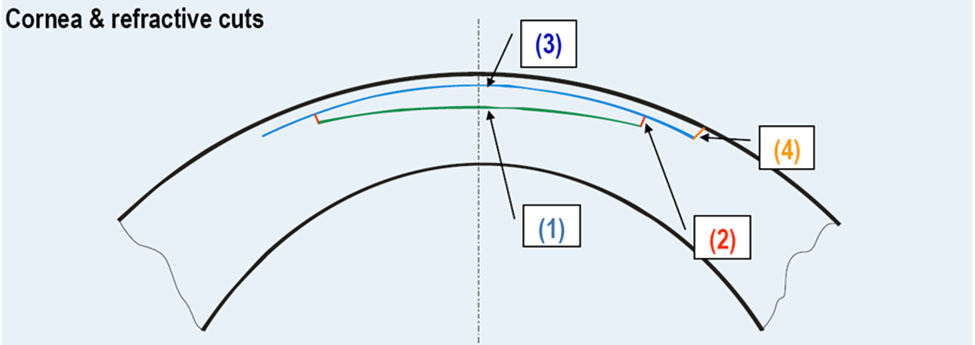
  • Green: Lenticule cut
  • Red: lenticule side cut (15um min thickness)
  • Blue: Cap cut (Cap thickness:120 um)
  • Orange: Cap side cut (depth:120 um)

Advantage of Lenticule Procedure- as there is no flap, there are no flap related complications. Recovery is fast like Femto Lasik

Disadvantage– Surgery has learning curve and experience of surgeons matters

Various Excimer Laser Ablation Profile:

There are different programs on different platform and special names are given to them, but basically all program will try to optimize/enhance the quality of vision after Laser refractive surgery

  • Wavefront Optimized/Aspheric ablation profile which maintains Sphericity of the Cornea- WFO from Alcon, SMARTSURF/SMARTPULSE from Schwind
  • Wavefront Guided (A-CAT)/ZYOPTIX HD: Ablation based on the wavefront map of the patient- indicated where aberrations are more
  • Topo-Guided LRS: indicated for enhancement procedures, irregular cornea
  • Topo-Guided (T-CAT) (Topolyser/Oculink)/CONTOURA: Same as Topolyser guided T-Customized ablation treatment (CAT) except the data used, are from Scheimpflug based Topographer/Topolyser
  • AI-Guided, Ray Tracing Technology/Wavelight Plus InnovEyes- from Alcon
  • Custom Q (F-CAT)/ALMOST ALL MACHINES: For the correction of Refractive to achieve a target Q value for that particular cornea of the patient, Wavelight from Alcon, Zyoptix HD from B & L

Your well experienced Doctor will decide, which program will suitably correct your refractive error best way.

Advantage of advanced customised correction:

Increased Accuracy and Safety, for better quality vision, giving better outcome

  • Latest advanced customised treatments are like, Smartpulse/SmartSurf-Schwind, Wavelight Plus InnovEyes/Contoura-Alcon, Zyoptix HD- B & L etc. (different names given by different company)
  • It results in a corneal shape that is closer to the normal curvature of the natural eye, thus reduces disturbance in aberrations induced by laser treatment or/& minimise the aberrations induced by laser treatment. Thus, it provides better quality for both, day, and night vision. It also reduces night time Glare and Haloes.
  • Also, sometimes removes 2%-10% less corneal tissue, which is healthier and safer
  • They are also particularly beneficial for patients with thinner than average corneas, larger pupils and higher or complicated Refractive errors, in some cases with little lesser best corrected visual acuity
POTENTIAL SIDE EFFECTS AND RISKS OF LASER REFRACTIVE SURGERY (LRS):

 Laser Refractive Surgery (LRS) Complications are extremely rare but couple of side effects includes-

  • All LRS will cause Dry eye which takes couple of weeks to months to settle down. Generally, lubricating drops are prescribed after surgery
  • Sometimes dryness may take little longer to settle down and there are many associated factors for that. Doctor will explain about them.
  • Visual side effects- After surgery, you may experience sensitivity to light, glare and coloured haloes around the light, variation, and fluctuation of vision. Usually all these disappear in time, from one week to three months. They are also related with pupil size. Sometimes they may affect your ability to drive and judge distances. Driving, especially nighttime driving, should only be started when you fill confident with your vision.
  • There is always possibility of over-correction or under-correction, as there are many factors which can influence your surgical outcome, including your body’s response to the surgery.
Complications of Laser Refractive Surgery:
  • Microkeratome (Blade) related complications- Buttonhole (in seep cornea-0.11%) (2), Thin/irregular flaps (0.82%) (2), Free Cap-Dislocated flap (In Flat cornea-1.67%) (2), Decentered flap (0.3-5.7%) (1), Incomplete flaps (0.36%) (2), Epithelial abrasions (0.93%) (2), Intra operative bleeding, Perforation (Rare)
  1. Steven C. Schallhorn, Eric C. Amesbury, David J. Tanzer. Avoidance, Recognition, and Management of LASIK Complications. Am J Ophthalmol 2006; 141:733–739
  2. J Refract Surg. 2007 Jun;23(6):592-7 Effect of preoperative keratometry power on intraoperative complications in LASIK in 34,099 eyes
  • Femto Flap related Complications – most of complications are nuisance rather than complications and with extra care surgery can be completed
  • Common Flap related Complications- Reaction beneath the flap (DLK), Folds/Striae in flap, Displacement of flap or detachment of flap, Thin flap, epithelial ingrowth, PISK- Pressure Induced Stromal Keratitis
  • Lenticule procedure- Advantage is no flap related complication. Can have reaction in the interface (DLK), Epithelial ingrowth, PISK, which are manageable.
  • Suction loss (Movement of patient or sudden squeezing of the eye during laser pass) is the only possible complication of Lenticule Surgery, where majority of time, surgery cannot be completed and need to plan some other technique after some resting time.
  • Because of dry spots over the cornea, sometimes Lenticule separation can become little difficult, delaying visual recovery.
  • PRK- there can be post-operative haze, typically appears between 2-3 months of surgery, which can alter surgical outcome. It is treated with medical management and rarely surgical intervention is required (Keloid tendency)
  • Most important complication is Post-LRS Ectasia. Here, cornea shape keeps on changing after LRS. To avoid this, evaluation of your corneal topography scan by well experienced Doctor is very crucial. Most of the time it is avoidable complication if properly evaluated and guided before surgery about the best possible LRS/Technique (Like PRK, LASIK, SMILE or Phakic lens) for that particular eye.
  • Other rare complication is infection. Mild infection can be treated with antibiotics and usually does not lead to permanent visual loss. Severe infection, even if successfully treated with antibiotics, could lead to permanent scarring and loss of vision that may require another corrective surgery. Very rare case, severe infection can lead to loss of the eye also
  • Though infection is very rare, dos and don’ts explained after surgery are, basically to prevent infection in the eye. First 3 weeks, absolute care should be taken to avoid infection in the eye
Phakic Lens/Phakic Implantable Intraocular Lens (PIOL)/Permanent Contact Lens
  • Please read in detail about it in Phakic Intraocular Lens (PIOL)
  • Please visit http://discovericl.com (staar.com) for more detail.
Difference In PRK/LASIK/SMILE Procedure
Bioptics
  • Total power correction by two procedures
  • E.g. – Phakic lens/permanent contact lens and Laser correction
Menu